Thursday, November 18, 2010
Cool Cup
The Ausction house Sotherby's will auction off a substantial private collection of African art in Paris on November 30th 2010, There is a lot to learn from this auction.
http://www.sothebys.com/liveauctions/A_New_York_Collection.pdf
This piece really intrigued me because of the two drinking receptacles on their underside, and the oddness of the hair and the squareness of the face compared to other Luba works. The squareness of the jaw reminds me more of the work of the Dagon people.
Magnificent Royal cup, Kalundwe peoples, western Luba, Democratic Republic of the Congo
(History: The Luba empire, which at one time stretched from the west all the way to Lake Tanganyika, was at its most powerful from around 1500 to the 1870's, when expansion reached east to lake's edge. The decline of Luba power began soon afterwards, and can be traced to Arab slave raiders and European colonialists, who did not recognize the power of Luba laws and rituals, and alas, also possessed rifles and horses. Though no longer politically powerful, Luba influences are still felt today throughout much of the DRC.)
Royal cups shaped like human heads with twin drinking receptacles on their underside are among the rarest of
Luba and Luba-related insignia. There are only a few such objects, and each is singular in its aesthetic elaboration.
Most cups of this type have emanated from Kanyok people and perhaps related groups to the west of the Luba heartland. This cup has been attributed to a workshop in the Kalundwe region (Felix 1987: 48-49; Neyt 1993: 212), not far from the Luba heartland, as evidenced by certain formal attributes. It also bears a close resemblance to a cup in the Berlin Museum für Völkerkunde, (now called The Ethnological Museum) purchased by the museum from Hermann Haberer in 1925.
The Berlin and this cup are similar: Each possesses a dramatic coiffure with elegantly striated, voluptuous
chignons, cowry-shell shaped eyes, and the tongue slightly protruding from the mouth. This cup does not have the metal pins that adorn the Berlin cup, which are used to "fasten the spirit" (Roberts and Roberts 1996: 68; 2007: 32).
However, this example does have a hole carved into the top of the coiffure which may have been used for the
insertion of powerful medicinal substances to activate the sculpted head and to render it efficacious.
Luba cups of this sort were documented by the late Albert Maesen, former Head of the Ethnography Section at the Royal Museum of Central Africa in Tervuren, who conducted research and a collecting mission in southern Belgian Congo in the 1950s. Maesen reports that among the Kanyok, royal drinking vessels were the only objects he was not permitted to see in a storeroom in which the ruler's emblems were guarded, including thrones and scepters. He was allowed to view the rectangular box in which the cups were kept, but he was informed that they were only used during a ruler's investiture and for other sacred occasions (A. Maesen, personal communication, 1987).
Maesen found that royal cups called musenge were also used in a ceremony to honor paternal ancestral spirits, when a titleholder made an offering of cooked cassava (also called yuca or manioc- Kalundwe is mad up of the word manioc, lulundu, plus the diminitive ka; the Bena Kalundwe are the "people of Manioc") while the ruler communed with his ancestors. The chief counselor named Shinga Hemb drank palm wine from one side of the cup and then passed it to the participants who drank from the other side. Similar acts were performed after divination or at the rising of a new moon (A. Maesen, personal communication, 1982).
The secrecy associated with these royal cups and their limited number suggests another possible association: Early colonial sources and oral traditions point to the importance of the skull of the previous ruler to the investiture of his successor. The skull was the vehicle through which the new ruler obtained power, blessing, and wisdom from his predecessor and validated his own link in the chain of political and moral authority. Quiet contemplation with the skull was essential to investiture, and some writers assert that the king consumed human blood from the cranium, to effect his transformation from an ordinary human being to a semi-divine ruler (Verbeke 1937: 59; Van Avermaet and Mbuya 1954: 709-711; Theuws 1962:216). Indeed, the Luba word for royalty, bulopwe," refers to "the status of the blood" (Roberts and Roberts 2007:32). It has been asserted that carved wooden cups might have replaced and symbolized the use of skulls in important rituals (Huguette Van Geluwe, personal communication, 1982). Such an assertion remains a hypothetical explanation for the existence of these beautifully carved and carefully concealed cups.
The gender of this strikingly sculpted head cannot be ascertained with certainty. Its elaborate coiffure would
suggest a female hairdo judging from other Luba emblems, yet chiefs and kings were known to don women's
coiffures during their investitures, thus reinforcing the complexities that Luba ascribe to political authority. In many contexts of Luba and Luba-related culture, women serve as guardians of royal secrets and possess other remarkable prerogatives and powers. They have long held roles as diplomats, ambassadors, advisors, and counselors to their male counterparts, and are responsible for the spiritual underpinnings of power itself. Only a woman's body is considered to be strong enough to hold the spirit of a king, and a king was often referred to as a woman by Luba officials. Such deliberately ambiguous gendering of power allows the special attributes of men and women to coalesce in bulopwe, the realm of royalty that is not qualified by gender, as the word "kingship" is in English-speaking contexts.
This particular royal cup has another trait that associates it with womanhood: its visibly protruding tongue. A Luba woman named Ngoi Zaina explained that this artistic motif was the sign of a woman ready for courtship, marriage, and childbearing, and therefore suggested that a woman was in the prime of her life (Nooter 1991: 250). Luba sculptures usually represent female figures with attributes of Luba beauty, including dense scarification marks and elegant coiffures. A spirit is attracted to an emblem of royal power that bears these marks of beauty, just as men are to those of a woman. In effect, a Luba cup such as this one must have been a magnet for spiritual power, a receptacle of royal secrets, and a symbol of continuity for the dynastic line.
Mary Nooter Roberts, UCLA
Labels:
African art,
drinking receptacle,
functional art,
Luba
Wednesday, November 3, 2010
Rarely seen Leonard Tsuguoharu Foujita sells at Sotherbys
One of the lesser know Modernist Leonard Tsuguoharu Foujita painting JEUNE FILLE À LA CORBEILLE DE FRUITS sold at Sotherby's Impressionist and Modern Day Art Sale in New York
on Wed, 03 Nov 10, for $350,000 USD. The piece came from a private collection.
There is a lot to like about this picture by Foujita- the smart foreshortening of the figure and the bench; the subtle coloring being most dramatic with the fuit; the position of the hand holding the peach?; the oversized head; the direct look; the imperfect mouth; the oddness of the background behind the sitter being in a sense framed by wood.
About Foujita
Leonard Tsuguoharu Foujita (November 27, 1886 – January 29, 1968) was a painter and printmaker born in Tokyo, Japan who applied Japanese ink techniques to Western style paintings.
In 1910 when he was twenty-four years old Foujita graduated from what is now the Tokyo National University of Fine Arts and Music. Three years later he went to Montparnasse in Paris, France. When he arrived there, knowing nobody, he met Amedeo Modigliani, Pascin, Chaim Soutine, and Fernand Léger and became friends with Juan Gris, Pablo Picasso and Henri Matisse. Foujita claimed in his memoir that he met Picasso less than a week after his arrival, but a recent biographer, relying on letters Foujita sent to his first wife in Japan, clearly shows that it was several months until he met Picasso. He also took dance lessons from the legendary Isadora Duncan [1].
Foujita had his first studio at no. 5 rue Delambre in Montparnasse where he became the envy of everyone when he eventually made enough money to install a bathtub with hot running water. Many models came over to Foujita's place to enjoy this luxury, among them Man Ray's very liberated lover, Kiki, who boldly posed for Foujita in the nude in the outdoor courtyard. Another portrait of Kiki titled "Reclining Nude with Toile de Jouy," shows her lying naked against an ivory-white background. It was the sensation of Paris at the Salon d'Automne in 1922, selling for more than 8,000 francs.
His life in Montparnasse is documented in several of his works, including the etching A la Rotonde or Café de la Rotonde of 1925/7, part of the Tableaux de Paris series published in 1929.[2] {From http://en.wikipedia.org/wiki/Tsuguharu_Foujita}
posted by Paul Grant (follower of Basho)
on Wed, 03 Nov 10, for $350,000 USD. The piece came from a private collection.
There is a lot to like about this picture by Foujita- the smart foreshortening of the figure and the bench; the subtle coloring being most dramatic with the fuit; the position of the hand holding the peach?; the oversized head; the direct look; the imperfect mouth; the oddness of the background behind the sitter being in a sense framed by wood.
About Foujita
Leonard Tsuguoharu Foujita (November 27, 1886 – January 29, 1968) was a painter and printmaker born in Tokyo, Japan who applied Japanese ink techniques to Western style paintings.
In 1910 when he was twenty-four years old Foujita graduated from what is now the Tokyo National University of Fine Arts and Music. Three years later he went to Montparnasse in Paris, France. When he arrived there, knowing nobody, he met Amedeo Modigliani, Pascin, Chaim Soutine, and Fernand Léger and became friends with Juan Gris, Pablo Picasso and Henri Matisse. Foujita claimed in his memoir that he met Picasso less than a week after his arrival, but a recent biographer, relying on letters Foujita sent to his first wife in Japan, clearly shows that it was several months until he met Picasso. He also took dance lessons from the legendary Isadora Duncan [1].
Foujita had his first studio at no. 5 rue Delambre in Montparnasse where he became the envy of everyone when he eventually made enough money to install a bathtub with hot running water. Many models came over to Foujita's place to enjoy this luxury, among them Man Ray's very liberated lover, Kiki, who boldly posed for Foujita in the nude in the outdoor courtyard. Another portrait of Kiki titled "Reclining Nude with Toile de Jouy," shows her lying naked against an ivory-white background. It was the sensation of Paris at the Salon d'Automne in 1922, selling for more than 8,000 francs.
His life in Montparnasse is documented in several of his works, including the etching A la Rotonde or Café de la Rotonde of 1925/7, part of the Tableaux de Paris series published in 1929.[2] {From http://en.wikipedia.org/wiki/Tsuguharu_Foujita}
posted by Paul Grant (follower of Basho)
Friday, May 1, 2009
The power of a picture- Photogropher Platon
The New Yorker and photographer Platon won a National Magazine Award for a series of portraits of American war veterans and their loved ones. This summer, the photographer Platon took pictures of hundreds of men and women who volunteered to serve in the military and were sent to Iraq or Afghanistan. He followed them on their journey through training and deployment, after demobilization and in hospitals, to compile a portrait of the dedication of the armed services today.

Colin Powell Cites Platon Photo In Obama Endorsement
President Bush's former Secretary of State Colin Powell was moved to endorse Barack Obama in part by a photo he saw in a magazine. On Meet The Press this morning, Powell said he was troubled by members of the Republican party falsely suggesting that Obama is a Muslim and therefore associated with terrorists:
"I feel strongly about this particular point because of a picture I saw in a magazine. It was a photo essay about troops who were serving in Iraq and Afganistan. And one picture at the tail end of this photo essay was a mother in Arlington Cemetry, and she had her head on the headstone of her son's grave. And as the picture focused in, you could see the writing on the headstone. And it gave his awards, Purple Heart, Bronze Star, showed that he died in Iraq, gave his date of birth, date of death. He was 20 years old. And then at the very top of the headstone, it didn't have a Christian Cross. It didn't have a Star of David. It had a crescent and a star of the Islamic faith. And his name was Kareem Rashad Sultan Khan. And he was an American."

Platon
Born in London in 1968, Platon was raised in the Greek Isles by his English mother, an art historian, and Greek father, an architect, until the age of seven when his family returned to London. He attended St. Martin's School of Art, and after receiving his BA with honors in Graphic Design, he was then awarded an MA in photography and fine art at the Royal College of Art, where one of his professors and mentors was the late John Hind, the creative director of British Vogue. While still a student, he received British Vogue's "Best up-and-coming Photographer" award in 1992, along with the opportunity to contribute both fashion and portrait images to the magazine.
Now an Englishman in New York, Platon left London in 1998 after spending a few years working for George, the magazine about politics and media culture founded by the late John F. Kennedy, Jr. Recruited to shoot for its premiere issue, Platon maintained a long-term relationship with the magazine and Kennedy, and this significant and incomparable introduction to American culture and politics included one of Platon's favorite assignments: a cross-country trip in order to document the 20 most fascinating men in America.
Since the early 1990s, Platon has continued to shoot portrait, fashion and documentary work for a range of international publications, including The New Yorker, Time Magazine, Rolling Stone, The New York Times Magazine, Vanity Fair, Harpers Bazaar, Esquire, GQ, Newsweek, Arena, The Face, i-D, The Sunday Telegraph, The Observer, and The Sunday Times. His advertising credits include campaigns for the Wall Street Journal, Motorola, Nike, Converse, Verizon, Vittel, Levi's, IBM, Rolex, Ray-Ban, Tanqueray, Kenneth Cole, Issey Miyake, Moschino, Timex and Bertelsmann among others.
In 2007 Platon photographed Russian Premier Vladimir Putin for Time Magazine's Person Of The Year Cover. This image was awarded the coveted 1 st prize at 2008 World Press Photo Contest.
Platon is now a staff photographer at The New Yorker, signing a multi-year contract in 2008.
Platon's first monograph "Platon's Republic", was published in 2004 by Phaidon Press. To coincide with its publication, he had solo portrait exhibitions at the Milk Gallery in New York and the Ex-Saatchi gallery in London. The same year, his first solo show of documentary work from around the world was held at the Leica Gallery in New York. His work also has been exhibited at Hamilton's Gallery in London, Spiral Hall in Tokyo, Carla Sozzani Gallery in Milan and Galerie Thierry Marlat in Paris.
Platon is represented worldwide by David Maloney, at Art Department in New York. He can be reached at (212) 925-4222 X108 or davidm@art-dept.com
Platon is based in New York where he lives with his wife, daughter and son.

Colin Powell Cites Platon Photo In Obama Endorsement
President Bush's former Secretary of State Colin Powell was moved to endorse Barack Obama in part by a photo he saw in a magazine. On Meet The Press this morning, Powell said he was troubled by members of the Republican party falsely suggesting that Obama is a Muslim and therefore associated with terrorists:
"I feel strongly about this particular point because of a picture I saw in a magazine. It was a photo essay about troops who were serving in Iraq and Afganistan. And one picture at the tail end of this photo essay was a mother in Arlington Cemetry, and she had her head on the headstone of her son's grave. And as the picture focused in, you could see the writing on the headstone. And it gave his awards, Purple Heart, Bronze Star, showed that he died in Iraq, gave his date of birth, date of death. He was 20 years old. And then at the very top of the headstone, it didn't have a Christian Cross. It didn't have a Star of David. It had a crescent and a star of the Islamic faith. And his name was Kareem Rashad Sultan Khan. And he was an American."

Platon
Born in London in 1968, Platon was raised in the Greek Isles by his English mother, an art historian, and Greek father, an architect, until the age of seven when his family returned to London. He attended St. Martin's School of Art, and after receiving his BA with honors in Graphic Design, he was then awarded an MA in photography and fine art at the Royal College of Art, where one of his professors and mentors was the late John Hind, the creative director of British Vogue. While still a student, he received British Vogue's "Best up-and-coming Photographer" award in 1992, along with the opportunity to contribute both fashion and portrait images to the magazine.
Now an Englishman in New York, Platon left London in 1998 after spending a few years working for George, the magazine about politics and media culture founded by the late John F. Kennedy, Jr. Recruited to shoot for its premiere issue, Platon maintained a long-term relationship with the magazine and Kennedy, and this significant and incomparable introduction to American culture and politics included one of Platon's favorite assignments: a cross-country trip in order to document the 20 most fascinating men in America.
Since the early 1990s, Platon has continued to shoot portrait, fashion and documentary work for a range of international publications, including The New Yorker, Time Magazine, Rolling Stone, The New York Times Magazine, Vanity Fair, Harpers Bazaar, Esquire, GQ, Newsweek, Arena, The Face, i-D, The Sunday Telegraph, The Observer, and The Sunday Times. His advertising credits include campaigns for the Wall Street Journal, Motorola, Nike, Converse, Verizon, Vittel, Levi's, IBM, Rolex, Ray-Ban, Tanqueray, Kenneth Cole, Issey Miyake, Moschino, Timex and Bertelsmann among others.
In 2007 Platon photographed Russian Premier Vladimir Putin for Time Magazine's Person Of The Year Cover. This image was awarded the coveted 1 st prize at 2008 World Press Photo Contest.
Platon is now a staff photographer at The New Yorker, signing a multi-year contract in 2008.
Platon's first monograph "Platon's Republic", was published in 2004 by Phaidon Press. To coincide with its publication, he had solo portrait exhibitions at the Milk Gallery in New York and the Ex-Saatchi gallery in London. The same year, his first solo show of documentary work from around the world was held at the Leica Gallery in New York. His work also has been exhibited at Hamilton's Gallery in London, Spiral Hall in Tokyo, Carla Sozzani Gallery in Milan and Galerie Thierry Marlat in Paris.
Platon is represented worldwide by David Maloney, at Art Department in New York. He can be reached at (212) 925-4222 X108 or davidm@art-dept.com
Platon is based in New York where he lives with his wife, daughter and son.
Thursday, April 23, 2009
Picasso's Bull Lithograph of 1945

Bull ( Plate I. - December 5 1945 )
(eleven developments of a lithograph)
Museum of Modern Art, New York
Pablo Picasso created 'Bull' around the Christmas of 1945. 'Bull' is a suite of eleven lithographs that have become a master class in how to develop an artwork from the academic to the abstract. In this series of images, all pulled from a single stone, Picasso visually dissects the image of a bull to discover its essential presence through a progressive analysis of its form. Each plate is a successive stage in an investigation to find the absolute 'spirit' of the beast.
To start the series, Picasso creates a lively and realistic brush drawing of the bull in lithographic ink. It is a fresh and spontaneous image that lays the foundations for the developments to come.
Picasso used the bull as a metaphor throughout his artwork but he refused to be pinned down as to its meaning. Depending on its context, it has been interpreted in various ways: as a representation of the Spanish people; as a comment on fascism and brutality; as a symbol of virility; or as a reflection of Picasso's self image.

Bull ( Plate II. - December 12 1945 )
(eleven developments of a lithograph)
At the second stage of the lithograph, Picasso bulks up the form of the bull to increase its expressive power and achieve a more mythical presence.

Bull ( Plate III. - December 18 1945 )
(eleven developments of a lithograph)
On Plate III. the development takes a change of direction. Picasso stops building the beast and starts to dissect the creature with lines of force that follow the contours of its muscles and skeleton. He cuts into the form of the bull much in the same way as a butcher would cut up a carcass. In fact, he was known to have joked with the printers about this butcher analogy. Also at this stage, Picasso introduces the use of a lithographic crayon to add more detail to the surface texture of the animal's skin. The overall effect is reminiscent of Dürer's famous images of a rhinoceros.

Bull ( plate IV. - December 22 1945 )
(eleven developments of a lithograph)
Plate IV. sees the artist start to abstract the structure of the bull by simplifying and outlining the major planes of its anatomy.
Ten years earlier Picasso had said that "A picture used to be a sum of additions. In my case a picture is a sum of destructions." In view of this statement, lithography seems to be the most natural choice of media for this series of prints. One of the technical advantages of lithography over other printmaking techniques is that you can both add to and subtract from the image with relative ease.

Bull ( plate V. - December 24 1945 )
(eleven developments of a lithograph)
The simplification and stylisation of the image continues on Plate V. Picasso starts to erase sections of the bull in order to redistribute the balance and reorganise the dynamics between the front and the rear of the creature.
First, he reduces its massive head and compresses its features into the small area that was previously the bull's forehead. By enlarging the eye and flattening its horns into a more lyrical design, he creates a sharper focal point at the front of the animal.
Next, he erases a section of the back which has the counter effect of raising the front. He literally underlines this change with the bold white line that runs diagonally across the animal, parallel to the new angle of the back. As a counterbalance to this movement, he strengthens a line that runs in the opposite direction across the middle of the body, parallel to the shoulders at the front.
Picasso's process of development is like building a house of cards where balance and counterbalance of the individual elements is crucial to the stability of the whole.

Bull ( plate VI. - December 26 1945 )
(eleven developments of a lithograph)
At this stage, another new head and tail are created to conform to the style and direction of the developing image.
Picasso introduces more curves to soften the network of lines that crisscross the creature. Once again he adjusts the line of the back which now begins as wave on the shoulders and flows like a pulse of energy along the length of its body. The two counterbalancing lines discussed in the previous plate are extended down the front and back legs to act like structural supports for the weight of the bull. All three of these lines intersect at a point that suggests the bull's center of balance. Through the development of these drawings, Picasso is beginning to understand the displacement of weight and balance between the front and rear of the animal.

Bull ( plate VII. - December 28 1945 )
(eleven developments of a lithograph)
As Picasso recognizes the balance of form in the bull, he starts to remove and simplify some of the lines of construction that have served their function. He then encases the essential elements that remain in a taut outline.

Bull ( plate VIII. - January 2 1946 )
(eleven developments of a lithograph)
Plate VIII. continues the reduction and simplification of the image into line with another reconfiguration of the head, legs and tail.

Bull ( plate IX. - January 5 1946 )
(eleven developments of a lithograph)
While continuing to have fun with the drawing of the head, Picasso now erases the remaining areas of tone and finally reduces the bull to a line drawing. Only the creature's reproductive organ retains its shading in order to emphasise its gender.

Bull ( plate X. - January 10 1946 )
(eleven developments of a lithograph)
At this penultimate stage, the more complex areas of the line drawing are removed to leave only a few basic lines and shapes that characterize the fundamental forces and correlation of forms in the creature.

Bull ( plate XI. - January 17 1946 )
(eleven developments of a lithograph)
In the final print of the series, Picasso reduces the bull to a simple outline that is so carefully considered through the progressive development of each image, that it captures the absolute essence of the creature in as concise an image as possible.
Labels:
1945,
Picasso,
Picasso's bull,
Picasso's bull lithograph
A fresh look at a Cubist picture by Picasso

THE WASHINGTON POST
Published: April 5, 2009
WASHINGTON
To watch a great art thinker's mind at work, we asked T.J. Clark to have a go at a Picasso that he hadn't known before, an untitled still life from 1918. It hangs in the East Building of the National Gallery.
The black
Clark had never really thought about Picasso's still life until we put him face to face with it. In reproductions that he's glimpsed, he's found the whole thing "terribly jolly." Not praise, coming from Clark. Standing in front of it, he's immediately struck by the "extraordinary black border" that wraps around three sides. That makes the whole scene graver, he says, noting how Picasso's black border creates a special tension between the "lighthearted bric-a-brac" that fills the painting's table and a sense of "grim confinement."
Coming very close to the painting, Clark points out how the dark paint actually covers areas in its bottom half that were once the same lively turquoise found on the painting's vase and cards. (The earlier paint peeks through cracks in the darker tones laid overtop.) Picasso, standing before his half-finished picture, seems to have had the same concerns about its "jolliness" as Clark.
Once Picasso had revised and completed the picture, Clark notes, he laid down a blood-red signature that crosses over between dark border and bright scene, laying claim to both.
The space
Clark is interested in the confined spaces and interiors you get in Picasso. Even when a picture's so kaleidoscopic that you can't make out the objects in it, he says, Picasso almost always gives a sense of the domestic space they're in. And, of course, you get just such a space in this picture's view into the corner of a room. Picasso, the great hater of abstraction, was always committed to delivering "something solid and felt," Clark said.
Stepping far back from the picture, Clark shows how well Picasso has achieved his end. What had looked like cubist complexities from up close resolve into a clear sense of a cluttered table standing in a corner with a chair. However close a Picasso painting comes to abstract pattern, Clark said, it has to "relate to some particular situation" in the real world.
Rather than dwelling on making each object separately clear and visible, that is, Picasso "wants to show us the way things in a certain world fit together." Picasso asks himself: "How imperiously can I play with these particular identities and still have them contribute to an overall interior?"
The past
For all its radically modern look, Clark said, the enclosed world seen in Picasso's pictures is essentially nostalgic. They depict the cozy world of a 19th-century bourgeois. For Picasso, Clark says, the bourgeoisie is a social force that is "both confining and wonderful." His interiors register that confinement, but they also revel in the comforts and objects that they gather into "the familiar space of the room."
Picasso had painted such old-fashioned rooms even when he was living in the mess of his unheated studio at the Bateau Lavoir. By 1918, when he's actually achieved the comforts of the bourgeoisie, he seems to step back from them -- to frame them in black and hold them up to sight.
The objects
Picasso depicts the "stock properties" of bohemian sociability -- guitar, sheet music, cards, fruit bowl, even maybe an absinthe spoon and glass at the front edge of the table. They are, Clark said, "utterly banal and familiar things -- they stand for the sufficiency of the bohemian world."
That world is "a mixture of the celebratory and the down-at-heels," Clark said. "Never was a carpet less luxurious -- or the stuffing in a chair." Although, in a typically Picassoid oxymoron, that down-at-heels carpet is also the one place in the painting where the artist resorts to showy brushwork.
By 1918, however, this very successful painter barely had a foot left in bohemia. His still life is looking back at something the artist has lost. The longer we look at the painting, Clark says, the more clearly it seems to be about "its stock properties being stock." Its vase and playing cards are cartoons of themselves, the fruits in its fruit bowl become four black-edged blobs of pink. "Never has fruit been more vestigial."
The moment
It, 1918, wasn't a good year for Europe, exhausted by a four-year war. If the painting wears black, that could be why.
Yet Clark insists that the picture is not portentous or histrionically doom-laden. Clark could imagine someone asking, "How dare a painter paint cards and a guitar in 1918 -- how can this painting be other than trivial?" And that's the question Picasso answers, in a painting of "tremendous gravity." Picasso, Clark said, wants us to "enter its world of familiar delights, but full of a sense of that world being something to struggle for."
The artist
The great achievements of cubism were over when this still life was painted, and there was a real risk that the movement was becoming empty style. "He knows that the moves are becoming too pre-established," Clark said. This last moment of cubism has the "terminal flavor" of "a language tremendously conscious of itself as a language, on the verge of just sedimenting up." The airless, lightless scene in this 1918 still life, Clark said, "is on the verge of not being vivid."
Clark wonders if Picasso uses the black border on this picture to show that he's aware of this. His border presents the scene as a work of art, as a framed picture, rather than as an unmediated view into a real portion of real space. That is, the painter is letting us know that he knows that his moves are starting to be more about painting than about the vivid world that they once showed.
Whereas earlier, fully cubist pictures, which tended to trail off into open blankness at their sides, had simply let us sense their space, without all the editorializing.
In this still life, then, Picasso's sense of space has started to register as a particular sense of confinement -- the confinement of a painter who feels trapped in an artistic style, too far from reality and truth.
Labels:
1918,
cubism,
National Gallery,
Picasso,
Picassoid oxymoron,
T.J. Clark
Friday, March 13, 2009
Video Portrait Comparison - Male vs Female
A nice video showing a comparison of drawing the face of a amle and female side by side
Tuesday, March 3, 2009
Artisitic potrayals of Woman Bathing in arts
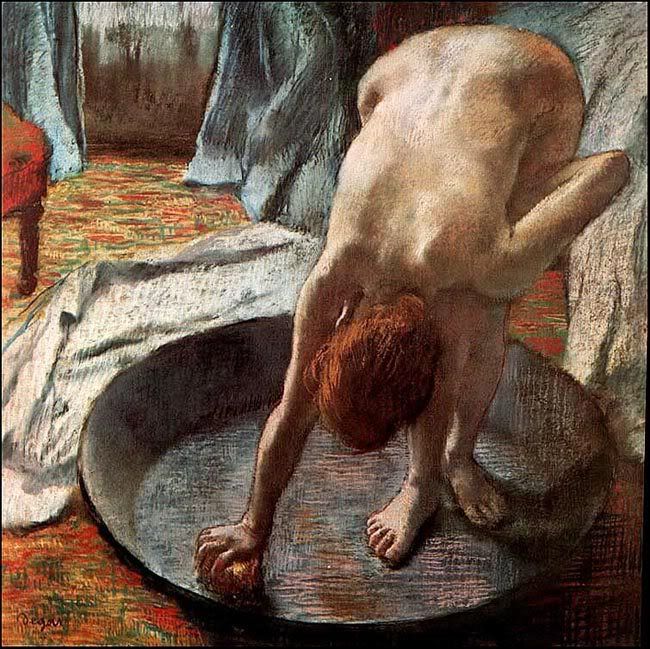
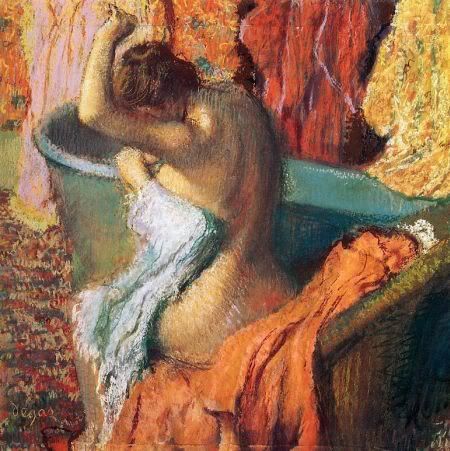
Degas drew a great deal of criticism for his late pastel nudes. Women were rarely ever seen in the intimate act of bathing or dressing... even by their husbands... at least not women of higher social status. As such, it was immediately assumed that all of Degas' women were prostitutes. The use of expressive colors and textures..unexpected points of view...and odd croppings (influenced by photography)...made his work even more shocking to the audience of his time.
Two Young Women Bathing in the Woods
1929
Roland Oudot, French, 1897–1981
"Women bathing." Paul Cézanne did many pictures of nude women bathing during his career and the Ordrupgaard collection has a good example that the catalogue notes was "made in the context of other pictures, photographs, and reproductions of nude figures form the Musée du Louvre and in Cézanne's early drawings and sketches of work by Delacroix, Michelangelo, Puget and Rubens." "This frieze-like composition - vivid as it is in painterly terms - is just as artificial, construced, and conceptual as his strange early figure paintings. ...In Cézanne's work the spiritual, in the Symbolist sense, has no place, just as his Utopian vision includes neither concrete nor imagined physical reality. His bathers are a far cry from the nymphs and carefree nude figures found in the pictures of Auguste Renoir and Henri Matisse. Cézanne's bathers are physically present but paradocially dispasionate and inactive. It is a concept of joie de vivre that lacks both joie and vivre."
Art Deco is an elegant style of decorative art, design and architecture which began as a Modernist reaction against the Art Nouveau style. It is characterized by the use of angular, symmetrical geometric forms. One of the classic Art Deco themes is that of 1930s-era skyscrapers such as New York's Chrysler Building and Empire State Building. The former, designed by architect William Van Alen, is considered to be one of the world's great Art Deco style buildings.
The Art Deco look is related to the Precisionist art movement, which developed at about the same time.
Well-known artists within the Art Deco movement included Tamara de Lempicka,
'A Woman bathing in a Stream (Hendrickje Stoffels?)'
1654
REMBRANDT
1606 - 1669
NG54. Holwell Carr Bequest, 1831.
Signed and dated bottom right: Rembrandt f 1654
The model is probably Hendrickje Stoffels (about 1625/6 - 1663). She lived in Rembrandt's household from about 1649 until her death. She became his common-law wife and bore him a daughter, Cornelia, who was baptised on 30 October 1654 (the year of this painting). It has been suggested that the sumptuous red robe on the river bank indicates that the painting might be a sketch for a religious or mythological picture; the model might be in the guise of an Old Testament heroine, such as Susanna or Bathsheba, or the goddess Diana, who were all spied upon by men while bathing. However, there is no evidence for a completed painting after this work and, moreover, Rembrandt did not use oil sketches as preparation for larger-scale paintings.
The handling of the paint is unusually spontaneous. The picture appears unfinished in some parts, for example, in the shadow at the hem of the raised chemise, the right arm and the left shoulder, but it was clearly finished to Rembrandt's satisfaction since he signed and dated it.
Oil on oak
61.8 x 47 cm.
Completed in 1892
Mary Cassatt - Woman Bathing - Colored Drypoint and Aquatint - 1891
Print from Woman Artist Mary Cassatt
Thursday, January 24, 2008
Art of Personal Devotion :: Santos
Cristo by Charlie Carrillo -Hide painting, like this contemporary Cristo, has a centuries-long history in the Southwest.
Santos:
The Art of Devotion
From the Collection of
Barbe Awalt (MA '76) and Paul Rhetts
In the first centuries after the Spanish settled the Southwest and introduced Catholicism 400 years ago, most people dwelt in villages miles from a church. They worshiped instead at home altars and in village chapels, where artwork depicting saints and holy scenes (santos) became a focus for personal devotion. Santos took several forms, including hide paintings, three-dimensional carvings (bultos), and paintings on prepared board (retablos). "The art is very simple. It speaks to people," says Barbe Awalt (MA '76), who together with her husband, Paul Rhetts, has accumulated one of the largest collections of santos in the country (see Contributors section). The pieces featured here are part of their traveling exhibit, "Our Saints Among Us: 400 Years of New Mexican Devotional Art."
Muerte by Charlie Carrillo La Sebastiana, the Muerte or Death Figure, is traditional in New Mexico. She is popular during Lent, especially on Good Friday when she is paraded through villages as a visible reminder that death is always around.
Barbe Awalt (MA'76) and her husband, Paul Rhetts, began collecting santos, paintings and carvings that depict saints and holy scenes, shortly after they moved to New Mexico in the late 1980s (See "Santos: The Art of Devotion,"). In the years since then their collection has grown to include 450 pieces (their oldest dates to 1770), and they've become good friends with many of the contemporary artists, or santeros, who are carrying on the 400-year-old tradition of devotional art.
Nuestra Señora del Pueblito de Querétero
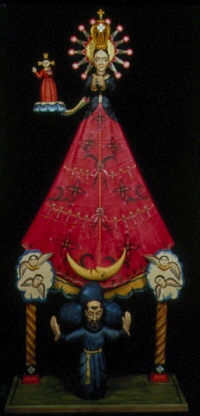
by Charlie CarrilloThis six-foot-high bulto of the Virgin coming forth with her angels exhibits all the traditional art forms of New Mexico. Her skirt is a hollow frame (fabric stretched over a dress-maker's form then gessoed to be stiff), and there are gold leaf accents, straw work, and sterling silver medallions on her crown. The figure at the bottom is St. Francis. The three globes represent the three Franciscan orders in the New World.
"It's a classic case of an art form taking over your life," says Awalt, who with her husband has written six books on the subject and has launched a quarterly magazine on the art and culture of Hispanic New Mexico, Tradición Revista.
Blue Cristo by Charle Carrillo If Christ were crucified in northern New Mexico at Easter, his skin would turn blue, explains artist Charlie Carrillo of his color choice here. Insulated against foreign influence, artists traditionally gave their saints a distinctly New Mexican look.
Earlier this year, they turned their collection into a traveling exhibit, which is being featured at sites throughout the Southwest. "It's really hit a chord with people that we never would have predicted," Awalt says. "It's not something they take lightly."
In the exhibit, the couple includes two altars where viewers can stop to kneel and pray--in keeping with the very personal devotional role santos have played in the four centuries since the Spanish introduced Catholicism to the Southwest. "For the people of New Mexico, the saints were a part of the family," explains Awalt. Likewise, [santos] themselves were "not considered artwork, but a member of the family." --SD
Nuestra Señora de la Paz by Krissa Marie Lopez
Note: Photos appearing in "Santos: The Art of Devotion," were taken by Awalt and Rhetts, with the exception of "Cristo" by Robert Reck, "Nacimiento" by Ron Behrmann, and the "bulto, also by Behrmann. All three of these shots appeared in Charlie Carrillo: Tradition and Soul.
Monday, January 21, 2008
Arshile Gorky a great Armenian artist
-by Paul Grant (follower of Basho)

Gorky, Arshile - ärˈshīl gôrˈkē, c.1900–48, though most often considered and categorizes an American painter, is more corectllty identified, in my opinion, as a great Armenian artist.
The man referred to as Arshile Gorky was born in Armenia as Vosdanig Adoian.
Can one imagine writing about the poet and Holocaust survivor Paul Celan without noting that he survived the Nazi's extermination plan for the Jews? And that his parents were Holocaust victims? Would one write about Marc Chagall's early work without delving into the climate of anti-Semitism in Russia during the first decades of the century? Or about Picasso's paintings of the '30s without a consideration of what the Spanish Civil War meant to him? It should be equally unthinkable to write about Gorky without articulating the context and facts of the Armenian Genocide. http://findarticles.com/p/articles/mi_m1248/is_n2_v84/ai_18004719/pg_2

"So there is, in Gorky's life, the suggestion of the absent father, the overachieving mother, and a child who preferred to carve or to draw, rather than to speak. And, in the distant background, a genocide."Matthew Spender, "Arshile Gorky's Early Life," in Arshile Gorky: The Breakthrough Years, pp. 28-32.
Gorky's birthplace was the lakeside village of Khorkom. A few miles to the west of Khorkom was the island of Akhtamar, with its famous tenth-century church, which Gorky later praised as "that jewel established in our crown of beauty."
In the years around 1910, Gorky's father attempted to avoid forced conscription into the army. He emigrated to America when Gorky had only 4.
As a tradition, the Ottoman Army drafted non-Muslim males only between the ages of 20 and 45 into the regular army. If Gorky's father had been conscripted - he would have faced almost certain death in 1915. "In the aftermath of the disastrous outcome of Enver Pasha’s winter offensive at Sarikamis, the Armenian soldiers in the regular army were disarmed out of fear that they would collaborate with the Russians. The order for this measure was sent out on 25 February 1915. Finally, the unarmed recruits were among the first groups to be massacred. These massacres seem to have started even before the decision was taken to deport the Armenians to the Syrian desert. (Source http://www.hist.net/kieser/aghet/Essays/EssayZurcher.html)
This massacre of Armenians was not the first. Armenians lived in bad conditions. In the Ottoman Empire, in accordance with the Muslim dhimmi system, Armenians, as Christians, were guaranteed limited freedoms (such as the right to worship), but were treated as second-class citizens. Christians and Jews were not considered equals to Muslims: testimony against Muslims by Christians and Jews was inadmissible in courts of law. They were forbidden to carry weapons or ride atop horses, their children were subject to the Devshirmeh system, their houses could not overlook those of Muslims, and their religious practices would have to defer to those of Muslims, in addition to various other legal limitations.[3] Violation of these statutes could result in punishments ranging from the levying of fines to execution.
Massacres of 1894-1896
The Hamidian massacres, also referred to as the Armenian Massacres of 1894-1896, refers to the massacring of Armenians by the Ottoman Empire, with estimates of the dead ranging from 80,000 to 300,000[1], and at least 50.000 orphans as a result[2]. The massacres are named for Abdul Hamid II, whose efforts to reinforce the territorial integrity of the embattled Ottoman Empire reasserted Pan-Islamism as a state ideology.[ Akcam, Taner. A Shameful Act. 2006, page 44.
Massacres of 1909
The Adana massacre occurred in Adana Province, in the Ottoman Empire, in April 1909. A religious-ethnic clash[1] in the city of Adana amidst governmental upheaval resulted in a series of anti-Armenian pogroms throughout the district. Reports estimated that the massacres in Adana Province resulted in 15,000 to 30,000 deaths.[2][3][4][5]
Turkish and Armenian revolutionary groups had worked together to secure the restoration of constitutional rule, in 1908. On 31 March (or 13 April, by the Western calendar) a military revolt directed against the Committee of Union and Progress seized Istanbul. While the revolt lasted only ten days, it precipitated a massacre of Armenians in the province of Adana that lasted over a month.
The massacres were rooted in political, economic,[6] and religious differences. The Armenian population of Adana was "richest and most prosperous", and the violence included the destruction of "tractors and other kinds of mechanized equipment."[2] The Christian-minority Armenians had also openly supported the coup against Sultan Abdul Hamid II, which had deprived the Islamic head of state of power. The awakening of Turkish nationalism, and the perception of the Armenians as a separatist, European-controlled entity, also contributed to the violence.[2]]
http://en.wikipedia.org/wiki/Adana_Massacre)
The Tehcir Law
The Tehcir Law ("Regulation for the settlement of Armenians relocated to other places because of war conditions and emergency political requirements") was passed by the Ottoman Parliament on May 27, 1915 and allegedly came into force on June 1, 1915, with publication in Takvim-i Vekayi, the official gazette of the Ottoman State
With the implementation of Tehcir law, the confiscation of Armenian property and the slaughter of Armenians that ensued upon the law's enactment outraged much of the western world. While the Ottoman Empire's wartime allies offered little protest, a wealth of German and Austrian historical documents has since come to attest to the witnesses' horror at the killings and mass starvation of Armenians.[32][33][34] In the United States, The New York Times reported almost daily on the mass murder of the Armenian people, describing the process as "systematic", "authorized" and "organized by the government." Theodore Roosevelt would later characterize this as "the greatest crime of the war."[35]


The Armenians were marched out to the Syrian town of Deir ez-Zor and the surrounding desert. A good deal of evidence suggests that the Ottoman government did not provide any facilities or supplies to sustain the Armenians during their deportation, nor when they arrived.[36] By August 1915, The New York Times reported that "the roads and the Euphrates are strewn with corpses of exiles, and those who survive are doomed to certain death. It is a plan to exterminate the whole Armenian people."[37]
Ottoman troops escorting the Armenians not only allowed others to rob, kill, and rape the Armenians, but often participated in these activities themselves.[36] Deprived of their belongings and marched into the desert, hundreds of thousands of Armenians perished.
Naturally, the death rate from starvation and sickness is very high and is increased by the brutal treatment of the authorities, whose bearing toward the exiles as they are being driven back and forth over the desert is not unlike that of slave drivers. With few exceptions no shelter of any kind is provided and the people coming from a cold climate are left under the scorching desert sun without food and water. Temporary relief can only be obtained by the few able to pay officials.[36]
Arshile Gorky's mother, Lady Shushanik der Marderosian, belonged to a distinguished Armenian family that could trace its origins back to the fifth century A.D. She was born in 1880 in Vosdan, a town just to the south of Lake Van in what is now eastern Turkey, in a valley of rushing streams and poplar groves. Just to the east of Vosdan stood the ancestral monastery (or vank) of the der Marderosians. At the time of Gorky's birth, in 1904, nearly 40 of his maternal ancestors lay buried at the vank, under elaborately carved tombstones. In later life he referred to his mother as "the last breath of Van nobility." She was his first teacher, and she seems to have been determined that her son should become an artist. (http://www.encyclopedia.com/doc/1G1-17501985.html)
Front View of St. Cross Monastery of Varak in Van.
When the family moved to the city of Van, in 1910, Lady Shushanik made sure that her son became familiar with the collection of illuminated manuscripts housed in the great monastery of Varak, which lay nearby. In a letter of 1945, Gorky wrote rapturously of "the medieval Armenian manuscript paintings with their beautiful Armenian faces, subtle colors, their tender lines and calligraphy." He might almost be describing his own paintings and drawings.

1938 Khorkom (above), and related works on the same theme, stand at this crossroads in the fertile years when Gorky felt his art should ocnvery his ‘living dreams’ of childhood memories and his ancient homeland
Traces of Cubist still life can be glimpsed in Gorky’s paintings of the 1930s, including the present work, Khorkom, where certain forms, such as a slice of apple, a palette, and the profile of a bird are vaguely identifiable amid the composition.
In 1915, when the Ottoman government embarked on its final solution of the "Armenian question." In April of that year, Khorkom was burnt to the ground, and the six members of Gorky's family who had remained in the village were murdered. In Vosdan seven cousins were killed, and the der Marderosian monastery was razed to the ground. The manuscripts of Varak were burnt, and Van was subjected to a savage month-long bombardment that reduced it to rubble. Gorky and his family then walked 150 miles to Yerevan, in Russian Armenia. There, four years later, his mother died in his arms. She was not yet 40. Gorky described her as "the most esthetically appreciative, the most poetically incisive master I have encountered in all my life."
In 1920, Gorky and his sister arrived at Ellis Island, and eventually moved to Providence, Rhode Island, where his father had emigrated earlier.Gorky was reunited with his father when he arrived in America in 1920, aged 16, but they never grew close. In 1922 Gorky enrolled in the New School of Design in Boston, eventually becoming a part-time instructor. During the early 1920s he was influenced by impressionism, although later in the decade he produced works that were more postimpressionist. Gorky moved to New York around 1925, and changed his name, passing himself off as Maxim Gorky's nephew- Arshile (a variant of Achilles) Gorky (an allusion to Maxim Gorky), and by repeatedly claiming to have been born in Tiflis, a city he merely passed through on his way to America. During this time he was living in New York and was influenced by Paul Cezanne. In 1927, Gorky met Ethel Kremer Schwabacher and developed a life lasting friendship. Schwabacher was his first biographer.
Arshile Gorky -"Organizations" painted between 1933-1936
Gorky talked of being "with" painters: "I was with Cézanne for a long time and then naturally I was with Picasso."[2] In the 1940s he was affected by the work of the European Surrealists, particularly Roberto Matta Echaurren. He married Agnes Magruder in 1941, and called her “Mougouch,” an Armenian term of endearment. In the summer of 1942 on a visit to Connecticut he began to work from nature, something he had not done for almost fifteen years. He was inspired by Kandinsky's early abstract landscapes as well as Miró 's and Picasso’s fusing of personal memories into his own procreant works from nature. The next year was spent at Crooked Run Farm, Mougouch’s parents’ estate in Virginia, where Gorky began a series of drawings in which the forms of nature were transformed into the artist’s singular abstract style. There he produced hundreds of drawings which he later drew on for his paintings. Landscape and interior space seemed to mingle and he emerged as a truly original and important artist.
In 1946 Gorky endured a devastating studio fire where he lost much of his work, then a colostomy for rectal cancer, and in 1948 a car accident left his neck fractured and his painting arm paralyzed (
Julien Levy, the famous art dealer was driving but only Gorky was injured).
His jealousy, aggression and paranoia were made worse by his tragedies, and the marriage collapsed under the strain. Mougouch, worn down by his dominance, hostility and violence, and out of desperation rather than betrayal, had a brief affair with Matta . However, Gorky felt betrayed; in a collar brace and brandishing a cane with his only functional hand, threatened Matta: “I’m going to give you a good beating. You are very charming, but you have interfered with my family life.” Matta fled, Gorky returned to his studio and hanged himself. (3)
Andre Breton
The tragic death of the man Breton considered one of the greatest painters in America devastated him, and it incensed him to think that his protégé, Matta, had precipitated the suicide of the man he cherished.
Roberto Matta [Chilean-born French Surrealist/Abstract Expressionist Painter, ca.1912-2002]
When Matta tried to explain that he had merely followed surrealist precepts, allowing him to be guided by unconscious desires (paraphrasing Marx, Breton had proclaimed “to each according to his desires”), the usually courteous and courtly Breton, like a modern Jeremiah, shrieked, “Assassin! Murderer!” He summoned a meeting of the Surrealist circle and Matta was excommunicated from the Surrealist group for “intellectual disqualification and moral ignominy.” (3)
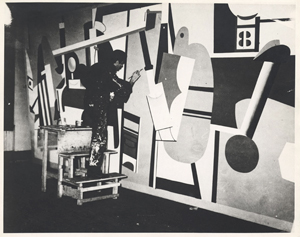
arshile gorky working on Aviation
Gorky hanged himself in Sherman, Connecticut, in 1948, at the age of 44. He is buried in North Cemetery in Sherman, Connecticut.
"Singing Tumanian's poems is a required part of my conduct when painting." (Mooradian, Arshille Gorky Adoian, pp. 287, 284. Hovaness Tumanian (1869-1923) was a major Armenian poet of the period.)
But still you live, standing erect in spite of all your wounds
on the mysterious journey of time, past and present,
still standing, wise and pensive, and sad, with your God ...
And the dawn of life´s happiness will come,
its light at last in thousands upon thousands of souls;
and on the sacred slopes of your Mount Ararat
will shine forth at last the flame of the time to come.
Then, with the dawn, new songs and new poems
will be on the lips of the poets.
Other Sources:
http://www.encyclopedia.com/doc/1G1-17501985.html
www.thecityreview.com/f00scon1.htm
(3)http://www.oberlin.edu/amam/Gorky_Plough.htm
http://www.martinries.com/article2007AG.htm
http://findarticles.com/p/articles/mi_m1248/is_n2_v84/ai_18004719/pg_1
5.0 out of 5 stars Life changing book, February 28, 2001
By A Customer
I read this book during a recent illness and I am glad of it because I was able to concentrate fully and stay within the world which the author so skilfully evokes. I have rarely found a biography of an artist, especially a modern one, so lovingly and painstakingly portrayed with brushstrokes just like a painter to produce image after image and make the man come alive in such an engaging way. I learned about the history of the ARMENIANS but through his eyes and yet the scholarship and objectivity shone through. So many insights and beautiful stories, such a strong sense of place, whether in long-lost Armenia or Boston of the 20s or New YOrk of the 30s and 4os , the characters who weave through this incredible tapestry, no a carpet. This writer belongs to the tradition of Armenian troubadours who were storytellers and sang their songs in verse in many languages. I felt the narrative had a poetic lilt and yet she kept back her obvious involvement in the subject. In her introduction which is worthy of attention Nouritza Matossian tells of her own family and their wanderings because of the Genocide, her desire to keep an even balance and not to succumb to the despair of her foretfathers. This book is a vindication of a culture which has been hammered and a Genocide which needs to be acknowledged. It tells of the courage of exiles and immigrants who brought such skills and moral values to this country which did not accept them very often. The accounts of Gorky's pursuit of excellence in art, his love for his mother and her inspiration are universal themes. I saw him as a quixotic, temperamental and charming character whom I would have loved to know. She brought him alive and I cared for him so much that I could hardly bear to finish the book, knowing that he would die. I received a great gift in understanding how it is possible for someone who has lived at traumatic life to transcend his suffering and 'give something to the world' as he said to Leger, something good. His paintings are incredibly beautiful and I see l know that he paid an even greater price than the loss of his childhood for those canvases, he paid for them with his health and security. Gorky's suicide has always puzzled me and I understand it for the first time after reading Matossian's book twice. The discussion of art and ideas, her ability to interpret him and even to depict the work is accurate and vivid. I saw from her website www.arshile-gorky.com that she performs a one-woman show in which she tells his story with slides and music as his mother, sister, sweetheart and wife. Those four characters are in the book and she pays tribute to them. It must be wonderful to hear this author tell her extraordinary story in her own words because this is a book which rings with her love and commitment for her subject and that is a rare and generous gift. All I could wish is that this book were even longer because I hated putting it down at the end. It changed my attitude to many things in my own life. This book deserves to win prizes.
From Publishers Weekly
Purely out of artistic ambition, Armenian-American abstract painter Gorky (1895-1948; born in Turkey as Vostanig Adoian) fabricated a new identity, complete with an Ivy League education and personal histories with master artists, on arriving in the United States. Spender (Within Tuscany), who is married to Gorky's oldst daughter, unhesitatingly exposes the painter's many "tall tales." He also assesses Gorky's difficulty in arriving at his own aesthetic until late in life in terms of both the artist's ties to the artistic patriarchs of the previous generation, the Surrealists (including Breton, Duchamp and Brancusi) and his complex status as a forerunner who eventually became alienated from the New York Abstract Expressionists (particularly de Kooning and Rothko). Spender derives much information from anecdotal sources, including an interview with de Kooning, and assumes a chatty tone in dealing with other artists. But he becomes increasingly less sympathetic to Gorky, whose last years are presented from the perspectives of Spender's wife and her mother. Nonetheless, painting constantly despite failing health, family problems and critical indifference, Gorky's frustrations are heartbreaking. Equally compelling is the window opened on New York's art scene when it was still a small clique. Gorky was so in love with the "artist" archetype that he not only lied about himself but also plagiarized anecdotes, artistic statements, love letters and possibly even his own suicide note. Spender preserves the personal dimensions of his subject while demonstrating that the painter should have adopted a youthful declarationA"I shall be a great artist or if not a great crook"Aas his motto. 90 b&w illustrations.
Copyright 1999 Reed Business Information, Inc.
Gorky, Arshile - ärˈshīl gôrˈkē, c.1900–48, though most often considered and categorizes an American painter, is more corectllty identified, in my opinion, as a great Armenian artist.
The man referred to as Arshile Gorky was born in Armenia as Vosdanig Adoian.
Can one imagine writing about the poet and Holocaust survivor Paul Celan without noting that he survived the Nazi's extermination plan for the Jews? And that his parents were Holocaust victims? Would one write about Marc Chagall's early work without delving into the climate of anti-Semitism in Russia during the first decades of the century? Or about Picasso's paintings of the '30s without a consideration of what the Spanish Civil War meant to him? It should be equally unthinkable to write about Gorky without articulating the context and facts of the Armenian Genocide. http://findarticles.com/p/articles/mi_m1248/is_n2_v84/ai_18004719/pg_2
"So there is, in Gorky's life, the suggestion of the absent father, the overachieving mother, and a child who preferred to carve or to draw, rather than to speak. And, in the distant background, a genocide."Matthew Spender, "Arshile Gorky's Early Life," in Arshile Gorky: The Breakthrough Years, pp. 28-32.
Gorky's birthplace was the lakeside village of Khorkom. A few miles to the west of Khorkom was the island of Akhtamar, with its famous tenth-century church, which Gorky later praised as "that jewel established in our crown of beauty."
In the years around 1910, Gorky's father attempted to avoid forced conscription into the army. He emigrated to America when Gorky had only 4.
As a tradition, the Ottoman Army drafted non-Muslim males only between the ages of 20 and 45 into the regular army. If Gorky's father had been conscripted - he would have faced almost certain death in 1915. "In the aftermath of the disastrous outcome of Enver Pasha’s winter offensive at Sarikamis, the Armenian soldiers in the regular army were disarmed out of fear that they would collaborate with the Russians. The order for this measure was sent out on 25 February 1915. Finally, the unarmed recruits were among the first groups to be massacred. These massacres seem to have started even before the decision was taken to deport the Armenians to the Syrian desert. (Source http://www.hist.net/kieser/aghet/Essays/EssayZurcher.html)
This massacre of Armenians was not the first. Armenians lived in bad conditions. In the Ottoman Empire, in accordance with the Muslim dhimmi system, Armenians, as Christians, were guaranteed limited freedoms (such as the right to worship), but were treated as second-class citizens. Christians and Jews were not considered equals to Muslims: testimony against Muslims by Christians and Jews was inadmissible in courts of law. They were forbidden to carry weapons or ride atop horses, their children were subject to the Devshirmeh system, their houses could not overlook those of Muslims, and their religious practices would have to defer to those of Muslims, in addition to various other legal limitations.[3] Violation of these statutes could result in punishments ranging from the levying of fines to execution.
Massacres of 1894-1896
The Hamidian massacres, also referred to as the Armenian Massacres of 1894-1896, refers to the massacring of Armenians by the Ottoman Empire, with estimates of the dead ranging from 80,000 to 300,000[1], and at least 50.000 orphans as a result[2]. The massacres are named for Abdul Hamid II, whose efforts to reinforce the territorial integrity of the embattled Ottoman Empire reasserted Pan-Islamism as a state ideology.[ Akcam, Taner. A Shameful Act. 2006, page 44.
Massacres of 1909
The Adana massacre occurred in Adana Province, in the Ottoman Empire, in April 1909. A religious-ethnic clash[1] in the city of Adana amidst governmental upheaval resulted in a series of anti-Armenian pogroms throughout the district. Reports estimated that the massacres in Adana Province resulted in 15,000 to 30,000 deaths.[2][3][4][5]
Turkish and Armenian revolutionary groups had worked together to secure the restoration of constitutional rule, in 1908. On 31 March (or 13 April, by the Western calendar) a military revolt directed against the Committee of Union and Progress seized Istanbul. While the revolt lasted only ten days, it precipitated a massacre of Armenians in the province of Adana that lasted over a month.
The massacres were rooted in political, economic,[6] and religious differences. The Armenian population of Adana was "richest and most prosperous", and the violence included the destruction of "tractors and other kinds of mechanized equipment."[2] The Christian-minority Armenians had also openly supported the coup against Sultan Abdul Hamid II, which had deprived the Islamic head of state of power. The awakening of Turkish nationalism, and the perception of the Armenians as a separatist, European-controlled entity, also contributed to the violence.[2]]
http://en.wikipedia.org/wiki/Adana_Massacre)
The Tehcir Law
The Tehcir Law ("Regulation for the settlement of Armenians relocated to other places because of war conditions and emergency political requirements") was passed by the Ottoman Parliament on May 27, 1915 and allegedly came into force on June 1, 1915, with publication in Takvim-i Vekayi, the official gazette of the Ottoman State
With the implementation of Tehcir law, the confiscation of Armenian property and the slaughter of Armenians that ensued upon the law's enactment outraged much of the western world. While the Ottoman Empire's wartime allies offered little protest, a wealth of German and Austrian historical documents has since come to attest to the witnesses' horror at the killings and mass starvation of Armenians.[32][33][34] In the United States, The New York Times reported almost daily on the mass murder of the Armenian people, describing the process as "systematic", "authorized" and "organized by the government." Theodore Roosevelt would later characterize this as "the greatest crime of the war."[35]


The Armenians were marched out to the Syrian town of Deir ez-Zor and the surrounding desert. A good deal of evidence suggests that the Ottoman government did not provide any facilities or supplies to sustain the Armenians during their deportation, nor when they arrived.[36] By August 1915, The New York Times reported that "the roads and the Euphrates are strewn with corpses of exiles, and those who survive are doomed to certain death. It is a plan to exterminate the whole Armenian people."[37]
Ottoman troops escorting the Armenians not only allowed others to rob, kill, and rape the Armenians, but often participated in these activities themselves.[36] Deprived of their belongings and marched into the desert, hundreds of thousands of Armenians perished.
Naturally, the death rate from starvation and sickness is very high and is increased by the brutal treatment of the authorities, whose bearing toward the exiles as they are being driven back and forth over the desert is not unlike that of slave drivers. With few exceptions no shelter of any kind is provided and the people coming from a cold climate are left under the scorching desert sun without food and water. Temporary relief can only be obtained by the few able to pay officials.[36]
Arshile Gorky's mother, Lady Shushanik der Marderosian, belonged to a distinguished Armenian family that could trace its origins back to the fifth century A.D. She was born in 1880 in Vosdan, a town just to the south of Lake Van in what is now eastern Turkey, in a valley of rushing streams and poplar groves. Just to the east of Vosdan stood the ancestral monastery (or vank) of the der Marderosians. At the time of Gorky's birth, in 1904, nearly 40 of his maternal ancestors lay buried at the vank, under elaborately carved tombstones. In later life he referred to his mother as "the last breath of Van nobility." She was his first teacher, and she seems to have been determined that her son should become an artist. (http://www.encyclopedia.com/doc/1G1-17501985.html)
When the family moved to the city of Van, in 1910, Lady Shushanik made sure that her son became familiar with the collection of illuminated manuscripts housed in the great monastery of Varak, which lay nearby. In a letter of 1945, Gorky wrote rapturously of "the medieval Armenian manuscript paintings with their beautiful Armenian faces, subtle colors, their tender lines and calligraphy." He might almost be describing his own paintings and drawings.
1938 Khorkom (above), and related works on the same theme, stand at this crossroads in the fertile years when Gorky felt his art should ocnvery his ‘living dreams’ of childhood memories and his ancient homeland
Traces of Cubist still life can be glimpsed in Gorky’s paintings of the 1930s, including the present work, Khorkom, where certain forms, such as a slice of apple, a palette, and the profile of a bird are vaguely identifiable amid the composition.
In 1915, when the Ottoman government embarked on its final solution of the "Armenian question." In April of that year, Khorkom was burnt to the ground, and the six members of Gorky's family who had remained in the village were murdered. In Vosdan seven cousins were killed, and the der Marderosian monastery was razed to the ground. The manuscripts of Varak were burnt, and Van was subjected to a savage month-long bombardment that reduced it to rubble. Gorky and his family then walked 150 miles to Yerevan, in Russian Armenia. There, four years later, his mother died in his arms. She was not yet 40. Gorky described her as "the most esthetically appreciative, the most poetically incisive master I have encountered in all my life."
In 1920, Gorky and his sister arrived at Ellis Island, and eventually moved to Providence, Rhode Island, where his father had emigrated earlier.Gorky was reunited with his father when he arrived in America in 1920, aged 16, but they never grew close. In 1922 Gorky enrolled in the New School of Design in Boston, eventually becoming a part-time instructor. During the early 1920s he was influenced by impressionism, although later in the decade he produced works that were more postimpressionist. Gorky moved to New York around 1925, and changed his name, passing himself off as Maxim Gorky's nephew- Arshile (a variant of Achilles) Gorky (an allusion to Maxim Gorky), and by repeatedly claiming to have been born in Tiflis, a city he merely passed through on his way to America. During this time he was living in New York and was influenced by Paul Cezanne. In 1927, Gorky met Ethel Kremer Schwabacher and developed a life lasting friendship. Schwabacher was his first biographer.
Gorky talked of being "with" painters: "I was with Cézanne for a long time and then naturally I was with Picasso."[2] In the 1940s he was affected by the work of the European Surrealists, particularly Roberto Matta Echaurren. He married Agnes Magruder in 1941, and called her “Mougouch,” an Armenian term of endearment. In the summer of 1942 on a visit to Connecticut he began to work from nature, something he had not done for almost fifteen years. He was inspired by Kandinsky's early abstract landscapes as well as Miró 's and Picasso’s fusing of personal memories into his own procreant works from nature. The next year was spent at Crooked Run Farm, Mougouch’s parents’ estate in Virginia, where Gorky began a series of drawings in which the forms of nature were transformed into the artist’s singular abstract style. There he produced hundreds of drawings which he later drew on for his paintings. Landscape and interior space seemed to mingle and he emerged as a truly original and important artist.
In 1946 Gorky endured a devastating studio fire where he lost much of his work, then a colostomy for rectal cancer, and in 1948 a car accident left his neck fractured and his painting arm paralyzed (
His jealousy, aggression and paranoia were made worse by his tragedies, and the marriage collapsed under the strain. Mougouch, worn down by his dominance, hostility and violence, and out of desperation rather than betrayal, had a brief affair with Matta . However, Gorky felt betrayed; in a collar brace and brandishing a cane with his only functional hand, threatened Matta: “I’m going to give you a good beating. You are very charming, but you have interfered with my family life.” Matta fled, Gorky returned to his studio and hanged himself. (3)
The tragic death of the man Breton considered one of the greatest painters in America devastated him, and it incensed him to think that his protégé, Matta, had precipitated the suicide of the man he cherished.
When Matta tried to explain that he had merely followed surrealist precepts, allowing him to be guided by unconscious desires (paraphrasing Marx, Breton had proclaimed “to each according to his desires”), the usually courteous and courtly Breton, like a modern Jeremiah, shrieked, “Assassin! Murderer!” He summoned a meeting of the Surrealist circle and Matta was excommunicated from the Surrealist group for “intellectual disqualification and moral ignominy.” (3)
Gorky hanged himself in Sherman, Connecticut, in 1948, at the age of 44. He is buried in North Cemetery in Sherman, Connecticut.
"Singing Tumanian's poems is a required part of my conduct when painting." (Mooradian, Arshille Gorky Adoian, pp. 287, 284. Hovaness Tumanian (1869-1923) was a major Armenian poet of the period.)
But still you live, standing erect in spite of all your wounds
on the mysterious journey of time, past and present,
still standing, wise and pensive, and sad, with your God ...
And the dawn of life´s happiness will come,
its light at last in thousands upon thousands of souls;
and on the sacred slopes of your Mount Ararat
will shine forth at last the flame of the time to come.
Then, with the dawn, new songs and new poems
will be on the lips of the poets.
Other Sources:
http://www.encyclopedia.com/doc/1G1-17501985.html
www.thecityreview.com/f00scon1.htm
(3)http://www.oberlin.edu/amam/Gorky_Plough.htm
http://www.martinries.com/article2007AG.htm
http://findarticles.com/p/articles/mi_m1248/is_n2_v84/ai_18004719/pg_1
5.0 out of 5 stars Life changing book, February 28, 2001
By A Customer
I read this book during a recent illness and I am glad of it because I was able to concentrate fully and stay within the world which the author so skilfully evokes. I have rarely found a biography of an artist, especially a modern one, so lovingly and painstakingly portrayed with brushstrokes just like a painter to produce image after image and make the man come alive in such an engaging way. I learned about the history of the ARMENIANS but through his eyes and yet the scholarship and objectivity shone through. So many insights and beautiful stories, such a strong sense of place, whether in long-lost Armenia or Boston of the 20s or New YOrk of the 30s and 4os , the characters who weave through this incredible tapestry, no a carpet. This writer belongs to the tradition of Armenian troubadours who were storytellers and sang their songs in verse in many languages. I felt the narrative had a poetic lilt and yet she kept back her obvious involvement in the subject. In her introduction which is worthy of attention Nouritza Matossian tells of her own family and their wanderings because of the Genocide, her desire to keep an even balance and not to succumb to the despair of her foretfathers. This book is a vindication of a culture which has been hammered and a Genocide which needs to be acknowledged. It tells of the courage of exiles and immigrants who brought such skills and moral values to this country which did not accept them very often. The accounts of Gorky's pursuit of excellence in art, his love for his mother and her inspiration are universal themes. I saw him as a quixotic, temperamental and charming character whom I would have loved to know. She brought him alive and I cared for him so much that I could hardly bear to finish the book, knowing that he would die. I received a great gift in understanding how it is possible for someone who has lived at traumatic life to transcend his suffering and 'give something to the world' as he said to Leger, something good. His paintings are incredibly beautiful and I see l know that he paid an even greater price than the loss of his childhood for those canvases, he paid for them with his health and security. Gorky's suicide has always puzzled me and I understand it for the first time after reading Matossian's book twice. The discussion of art and ideas, her ability to interpret him and even to depict the work is accurate and vivid. I saw from her website www.arshile-gorky.com that she performs a one-woman show in which she tells his story with slides and music as his mother, sister, sweetheart and wife. Those four characters are in the book and she pays tribute to them. It must be wonderful to hear this author tell her extraordinary story in her own words because this is a book which rings with her love and commitment for her subject and that is a rare and generous gift. All I could wish is that this book were even longer because I hated putting it down at the end. It changed my attitude to many things in my own life. This book deserves to win prizes.
From Publishers Weekly
Purely out of artistic ambition, Armenian-American abstract painter Gorky (1895-1948; born in Turkey as Vostanig Adoian) fabricated a new identity, complete with an Ivy League education and personal histories with master artists, on arriving in the United States. Spender (Within Tuscany), who is married to Gorky's oldst daughter, unhesitatingly exposes the painter's many "tall tales." He also assesses Gorky's difficulty in arriving at his own aesthetic until late in life in terms of both the artist's ties to the artistic patriarchs of the previous generation, the Surrealists (including Breton, Duchamp and Brancusi) and his complex status as a forerunner who eventually became alienated from the New York Abstract Expressionists (particularly de Kooning and Rothko). Spender derives much information from anecdotal sources, including an interview with de Kooning, and assumes a chatty tone in dealing with other artists. But he becomes increasingly less sympathetic to Gorky, whose last years are presented from the perspectives of Spender's wife and her mother. Nonetheless, painting constantly despite failing health, family problems and critical indifference, Gorky's frustrations are heartbreaking. Equally compelling is the window opened on New York's art scene when it was still a small clique. Gorky was so in love with the "artist" archetype that he not only lied about himself but also plagiarized anecdotes, artistic statements, love letters and possibly even his own suicide note. Spender preserves the personal dimensions of his subject while demonstrating that the painter should have adopted a youthful declarationA"I shall be a great artist or if not a great crook"Aas his motto. 90 b&w illustrations.
Copyright 1999 Reed Business Information, Inc.
Thursday, June 21, 2007
the brain reacts to symmetry in the occipital lobe, the primary part of the brain that reacts to visual stimuli

by Elizabeth Roth
“Not only does the mind create art, it also perceives it,” began Randy Blakely, Ph.D., Allan D. Bass Chair in Pharmacology, and director, Center for Molecular Neuroscience, in his introduction of Dr. Christopher Tyler. Tyler, of the Smith Kettlewell Eye Institute, delivered the second lecture in the 2002 Brain Awareness program recently at the Frist Center for the Visual Arts.
Tyler discussed how the brain perceives symmetry and how artists, consciously or unconsciously, create their art based on an understanding of symmetrical principles.
Symmetry is a key visual property for humans. Its importance is expressed in its ubiquitous use as a design principle in everything humans construct, from architecture to the pattern in Oriental rugs.
Defined as balanced form, a beauty of form arising from balanced proportions, it is no surprise, then, that elements of symmetry are apparent in works of art. But, it is only partial symmetry that we see. In many of the Renaissance works Tyler presented, architectural elements of a painting were symmetrical while figures in the foreground were arrayed. Similar examples from other eras and artistic styles were presented as well.
Perhaps, it was theorized, that artists were unconsciously using symmetry to represent order, harmony, or serenity while the asymmetrical elements depicted that life and art are not perfect and therefore, cannot be perfectly symmetrical.
8

Perception, symmetry of art discussed at brain lecture
Through functional magnetic resonance imaging, it is clear that the brain reacts to symmetry in the occipital lobe, the primary part of the brain that reacts to visual stimuli. Tyler’s research indicates that human symmetry processing is hard-wired. In a matter of less than .05 of a second, humans instinctively scan a visual object for symmetrical qualities.
Questions were raised during the lecture about an evolutionary bias toward symmetry, possibly due to the fact that symmetrical bodies, biologically speaking, seem to be the best designed for procreation. Studies have shown that those human faces that are widely considered to be the most attractive are also quite symmetrical. Is this equivocation of symmetry to beauty, as was asked during the lecture, why humans very often tilt their head to one side as they speak directly to someone, or they stand with one foot forward, at an angle, perhaps in an attempt to mask any asymmetry? Could this explain the subconscious attention to symmetry in so many works of art?? Could this explain the subconscious attention to symmetry in so many works of art?
Symmetrical elements are often found in artistic works, and specifically paintings throughout many eras. Tyler noted that one of the clues to the importance of symmetry is evident in the placement of eyes in painted portraits.
According to Tyler, a survey of portraits over the last two millennia revealed that throughout history, one eye tended to be placed symmetrically at or near the vertical axis of the canvas. This placement violates the inherent symmetry of the face and body, but expresses a deeper symmetry and concentration on the “window on the soul.” Perhaps the artists felt it was more accurate to represent their subjects in their realistic imperfection.

Interestingly, Tyler found this theme to be present in diverse works from various cultures. Despite Tyler’s extensive research, he indicated that he was unable to find any reference to this principle, leaving him to conclude that the artists were not purposefully centering eyes in their portraits, but rather, did so unconsciously.
From Publishers Weekly
Anyone who thinks math is dull will be delightfully surprised by this history of the concept of symmetry. Stewart, a professor of mathematics at the University of Warwick (Does God Play Dice?), presents a time line of discovery that begins in ancient Babylon and travels forward to today's cutting-edge theoretical physics. He defines basic symmetry as a transformation, "a way to move an object" that leaves the object essentially unchanged in appearance. And while the math behind symmetry is important, the heart of this history lies in its characters, from a hypothetical Babylonian scribe with a serious case of math anxiety, through Évariste Galois (inventor of "group theory"), killed at 21 in a duel, and William Hamilton, whose eureka moment came in "a flash of intuition that caused him to vandalize a bridge," to Albert Einstein and the quantum physicists who used group theory and symmetry to describe the universe. Stewart does use equations, but nothing too scary; a suggested reading list is offered for more rigorous details. Stewart does a fine job of balancing history and mathematical theory in a book as easy to enjoy as it is to understand.Line drawings. (Apr.)
Copyright © Reed Business Information, a division of Reed Elsevier Inc. All rights reserved.
Friday, May 25, 2007
Art Qoute
"I feel that talent means little unless coupled with an insatiable desire to give an excellent personal demonstration. "
"It is ten per cent how you draw and ninty percent what you draw."
Realistic Face coloring
The head of Saint John the Evangelist by Fredrico Barocci 1580
Here’s a few general rules:
* The cheeks and lips are pinker, or more rosy.
* The nose is generally redder, or warmer.
* The jaw, chin, and mustache areas are often cooler, especially in men.
* The forehead is paler, and more yellow.
* The eye socket areas are darker and more purple.
MAD Magazine artist and illustrator Tom Richmond shares some of his digital line and color painting techniques in this video. Actual painting time without time lapse: 16 minutes
Saturday, April 21, 2007
Pete Christman Photograph

Christman Combines Classic Vision With New Technology
Pete Christman, the longest-serving professor at the Savannah College of Art and Design, said three things are essential to his artistic process: painting, photography and computers.
It's easy to see that his work, on display in "Modern Pictorialism" at the Jack Leigh Gallery, 132 E. Oglethorpe Ave., through March 16, utilizes photographic materials. His landscapes do not have the effervescence of en plein air but a curious, observed quality. Rough brushstrokes define shapes and light billowing through canopies of trees; off-perspective skies draw attention away from the foreground rather than playing the part of ambient backdrop.
Pete Christman Red Woods
Pete Christman incorporates photography, painting with peanut butter and computer technology into his work.
Christman's methods are unconventional; he proudly lists among his media paint, photography, digital prints and peanut butter.
Last summer, Christman, a photography professor, traveled to California and South Carolina and throughout Savannah, taking photographs of landscapes and nature that reflected visions from master painters such as Monet, Caravaggio and Rembrandt. But Christman, existing in another time than these artists, said he felt that emulating centuries-old work would be problematic and knew he had to give his impression of the world he lives in to his audience.
"I feel that my work has little to do with the second half of the 20th century," he said. "However, this is the time I live in. My work is a product of today, and I wouldn’t be able to do any of this if it wasn’t for computers — or photography. They allow me to put my images together."
Inspired by light and atmosphere, Christman’s work harkens to Monet, but he admitted that these images are strictly postmodern because they are equally about media. He cited famed photographer Alrfred Stieglitz's modern-day vision as an additional influence.
Christman's process — which combines his two preferred media (photography and painting) — entails plating the digital image with a sheet of glass, and then "painting" on the glass with a readily available material — peanut butter — to create an impasto surface. He then transfers another digital image of the peanut butter painting to his computer, where he combines the two digital images in a process called displacement mapping. A layer of encaustic wax assists in creating the desired depth on the surface of the image.
The result is an odd blend of abstraction and impressionism in which Christman achieves his goal — to focus attention on the illumination of the painting.
"Language is the DNA of civilization. It can be words, but it can also be music or something visual," Christman said.
Article by Ally Hughes
There are three categories of artistic content. The landscape studying space, perspective and atmosphere. The still life concentrating on formal design, color and symbolism. And the portrait focusing on documentation, fiction and the human condition. I have worked in all three of these genres over the years, testing them out in both the mediums of painting and photography, and always keeping them separate from each other for purpose of simplification and clarity. But now, I examine the three together, a natural progression like the linear development of an idea in literature, journalism, theater, film or music. This installation merges ideas and experiences and gives an opportunity to see all of these three categories in a new way. My goal is for the viewer to put the pieces together, ask their own questions and find their own answers - inside each diorama.
Wednesday, April 11, 2007
Carlos Alfonzo: Where Tears Can't Stop

Where Tears Can't Stop
1986
Carlos Alfonzo
acrylic on canvas
95 3/4 x 128 1/4 in. (243.2 x 325.8 cm.)
Smithsonian American Art Museum
Museum purchase made possible by the American Art Forum
1998.18
On view at:
Smithsonian American Art Museum
3rd floor, East Wing
Alfonzo borrowed from Cuban Santería*, medieval Catholic mysticism, and tarot cards to build a dense network of symbols floating in huge limpid tears. Where Tears Can't Stop reflects the violence that Alfonzo experienced before he fled with the Marielitos exiled by Castro in 1980. But the work also holds subtle clues that evoke Alfonzo's homosexuality and the fear and anger generated by the AIDS epidemic. In the mid-1980s, Americans coming to terms with thousands of deaths began to piece together enormous quilts—as the artist stitched together several canvases for this image—filling them with symbols of suffering, loss, and defiance. In Alfonzo's painting, the image of a tongue spiked by a dagger is a Santería charm against gossip and the "evil eye," two responses to HIV-positive men that were common in the epidemic's early years. Rumors and innuendo shaped the perception that AIDS was only a gay man's disease, and the evil eye recalls a widespread belief that the tears of the infected carried the virus. Alfonzo died of AIDS five years after he completed this work.
Exhibition Label, Smithsonian American Art Museum, 2006
*Santeria, commonly referred to as Latin American magic, is a fused religion that intertwines aspects of Roman Catholicism as it is practiced in Cuba with "magic." Although the vast majority of santeros, followers of the religion, are found in Cuba, Santeria is by no means indigenous to the island. Santeria, deriving from the Spanish word santo, or saint, is the Cuban name for this religion because of the significance of saint worship. Despite the trappings of the Catholic sainthood, Santeria remains intrinsically an African religion that
originated on the shores of the Nile River in present-day Nigeria among the Yoruba tribe. It was inevitable that the religion would reach Cuba along with the slaves being imported from Africa in the slave trade.
Like most other African tribes in the process of creating a systematized, tangible religion, the Yoruba conceptualized "God" as an unknown mysterious, creating force. Beneath the omnipotent god is a pantheon of orishas, gods and goddesses that are extraordinarily human.
There are many orishas in the pantheon. Some African authorities say the number exceeds 600. However, only a few of these are known and paid homage to throughout Latin America and the Caribbean.
----
Carlos Alfonzo
Period: Contemporary
1950 - 1991
Murano water, 1987, Acreylic on canvas
60 x 43 1/2 inches
Carlos Alfonzo was born in Havana, Cuba in 1950. He went to the San Alejandro School of Plastic Arts and then to the Cuban Academy from 1969 to 1972. A year later, he attended the University of Havana, graduating in 1977.
Carlos Alfonzo died in Miami, FL in 1991.
"In Cuba I was a well known artist. I had found a formula --swarms of little figurines and the integration of literary texts--through which I could deal with many themes without raising suspicion or criticism. Painters younger than I were told that I was something like the limit of what was allowed, to go beyond could cause problems with the cultural authorities. When I arrived in the United States it took me more than a year to start painting again. The arrival, the trip from the Port of Mariel, was a shock. My fundamental search has been in the structural form, in how to paint an image, in how to let the hand go. This has been my only preoccupation, since I have never had conceptual conflicts with my work. My interest as a painter is to create new symbols, rather than employ conventional imagery. My identification with religion is that of creator more than interpreter. The symbology is important, the tongue for me represents oppression; the cross--and I use many crosses in my work-- has mystical connotations, it represents a spiritual balance, sacrifice; the tears are a symbol of exile. My paintings have to do with my exile, with my personal drama as I see it."
Monday, April 9, 2007
Robert Tatin's Frénouse
In what is perhaps the earliest surviving example of symbolism, the cave painters of the Upper Palaeolithic period drew geometrical patterns, thought to represent man and woman, at the Lascaux and the Chauvet caves in present-day France. Some 25,000 years later, at a ruined country house at the edge of the Mayenne woods near Laval, a French artist named Robert Tatin constructed a courtyard of totems and temples, decorated with the ancient Chinese symbols of Yin and Yang, and covered with interlacing geometric representations of woman and man, the moon and the sun. Robert Tatin bought the house, the Frénouse, near the small town of Cossé-le-Vivien in 1962. Rich in history, part of its stonework dates from the sixth century, while stone axes from the Neolithic period had been discovered in the fields nearby. Over a period of twenty-one years, with the assistance of his fifth wife, Lise, Robert Tatin created a magical cement fortress, where goddesses, dragons, snakes and fairies dance among bas-reliefs of ancient Chinese and Breton symbols, celebrating man’s union with nature and the cyclical passage of time.
The approach to the house and museum is flanked by wide-eyed, totemic figures. Guarding the 80-metre-long Avenue of Giants are nineteen statues representing Tatin’s historic and artistic family, from Joan of Arc to Alfred Jarry. Next to the Avenue of Giants is The Gateway of the Giants, a homage to some of the father-figures of western art: Leonardo da Vinci, Rembrandt, Delacroix, Goya, and Van Gogh. The story told by this company of giants also traces the development of the artist’s own life, from his first history lessons, to his professional career, personified by a top-hatted carpenter, to the artists who influenced him, pointing finally to his own grave. Once inside the museum, however, the linear structure is abandoned. Over a surface of 1,200 square metres, the artist has created a miniature universe, incorporating the sun, moon, and sea. Consisting of three main temple-like structures, reflected in a cross-shaped pond, the courtyard and adjoining house are articulated on an east-west axis. Facing the entrance is the towering Notre-Dame-Tout-le-Monde, to the east is The Gateway of the Sun, and to the west The Gateway of the Moon. The journey through the museum follows the direction of the earth’s rotation, guided by statues around the central pool indicating the successive months of the year. Tatin’s paintings, sculptures, ceramics and tapestries are displayed in adjoining rooms.

‘I’ve got to face many tide-gates before becoming Tatin’, Robert Tatin once declared, and his varied professional life and extensive travels lived up to this prophecy. A sculptor, painter, architect, ceramicist, and poet, he also did stints as a tailor, baker, carpenter, decorator, coalman, and bartender, and travelled Europe, North and South America, and Africa. The Frénouse allowed Tatin to combine his artistic skills and cultural influences in one long enterprise, in which work was no longer separated from life. Born in 1902, Robert Tatin grew up near a circus. Trapeze artists, clowns, and ragamuffins were his companions in this enclosed universe of painted horses and pedlars with their orientalist wares. In 1910, the return of Halley’s comet sparked Tatin’s interest in a wider, scientific universe and he fashioned himself a telescope with which to gaze at stars from his attic window. At the age of eleven he began an apprenticeship as a house painter, moving to Paris five years later to work as a decorator, before setting off to Switzerland, Italy, North Africa, England, Ireland, Amsterdam, and New York. After the Second World War he settled again in Paris, where he set up a ceramics studio and exhibited regularly.
An article in France-Soir of 1948 brought Tatin’s work to the attention of Jean Dubuffet and he began to mix with such art world figures as Jean Cocteau, André Breton, Jacques Prévert, and Alberto Giacometti, becoming instrumental in the development of Dubuffet’s concept of Art Brut. Ever restless, Tatin left France again in 1950 to spend five years travelling in South America, winning a gold medal at the first Biennale of Saõ Paõlo, Brazil. Upon his return he devoted himself almost exclusively to painting, before meeting Lise and returning to his native Mayenne in 1962. Tatin conceived of the Frénouse as a ‘bridge between Orient and Occident’ and his sculptural architecture combines the influence of many, far-flung cultures, from ancient Chinese philosophy, to Celtic, Hindu, and Aztec symbols, to the emerging Surrealist movement. Although Tatin refused to sign André Breton’s Surrealist Manifesto of 1924, the influence of Surrealism and its use of word association is evident in his poetry.
Facing the entrance to the museum, the totem tower of Notre-Dame-Tout-le-Monde rises 6.5 metres high. A star is carved at its base, ‘the star of the three wise men – a gleam even in the deepest Hell’, and enclosed within a circle, the universe, which is contained within a square, representing man. Facing each other on either side of Notre-Dame are the Gateways of the Sun andthe Moon. With these two structures, Tatin aimed to show how night and day, female and male, imagination and reason are opposite forces that must come together to create a complete picture of the universe. A classical structure, The Gateway of the Sun is supported by two columns, which Tatin described as embodiments of the Taoist symbols of Yin and Yang, the complementary masculine and feminine energies that shape the universe. Yin is the female, the earth, while Yang is the male, the light and the sun, and heaven. On the plateau the wheel of destiny turns between the horns of reason and imagination and on the tympanum is the great face of the sun. As the sun shines, its rays fracture into hundreds of smaller spheres with human features. ‘This is the sun’, according to Robert Tatin, ‘coming out of itself, splitting up its rays, sharing its light, energy and life with all the world’. The division of the sun’s light is like the fracturing of God’s Word into different human languages, a comparison that Tatin makes in a poem, where the sound splits to create related words: ‘voir: le Verbe sortir à la Voix – Se Sortir de soi – quitter – Go – PIR KHROOU’ (see: the Word issuing from the Voice – Coming Out of itself – quitter – Go – PIR KHROOU). With its undulating roof, The Gateway of the Moon is a more feminine structure. A goddess (the muse of unity), crouches above the arches, her blond locks flowing, a boy and a girl at her breasts, and her right foot resting on a square (the cube of reason), her left on a circle (the imagination).

The circle is the defining motif of the Frénouse, a shape that haunted Tatin, from his early obsession with the enclosed ring of the circus, to his adolescent observation of planets. It embodies the universal, unifying purpose of the Frénouse, denoting the celestial sphere, the wheel of destiny, the female breast, the eyes that are a window to the soul, and the divided circle of Yin-Yang. The two gateways, according to Robert Tatin, with their Yin-Yang symbols, their interlacing circles and squares, and androgynous figures, eradicate all separation of the sexes: ‘Here there is no longer any duality between woman and man; it is as if we are with the gods of the legends and difference doesn’t exist any more.’ In the artist’s symbolism, however, woman retains her traditional association with the irrational, man with the forces of light and reason.
Subscribe to:
Posts (Atom)